

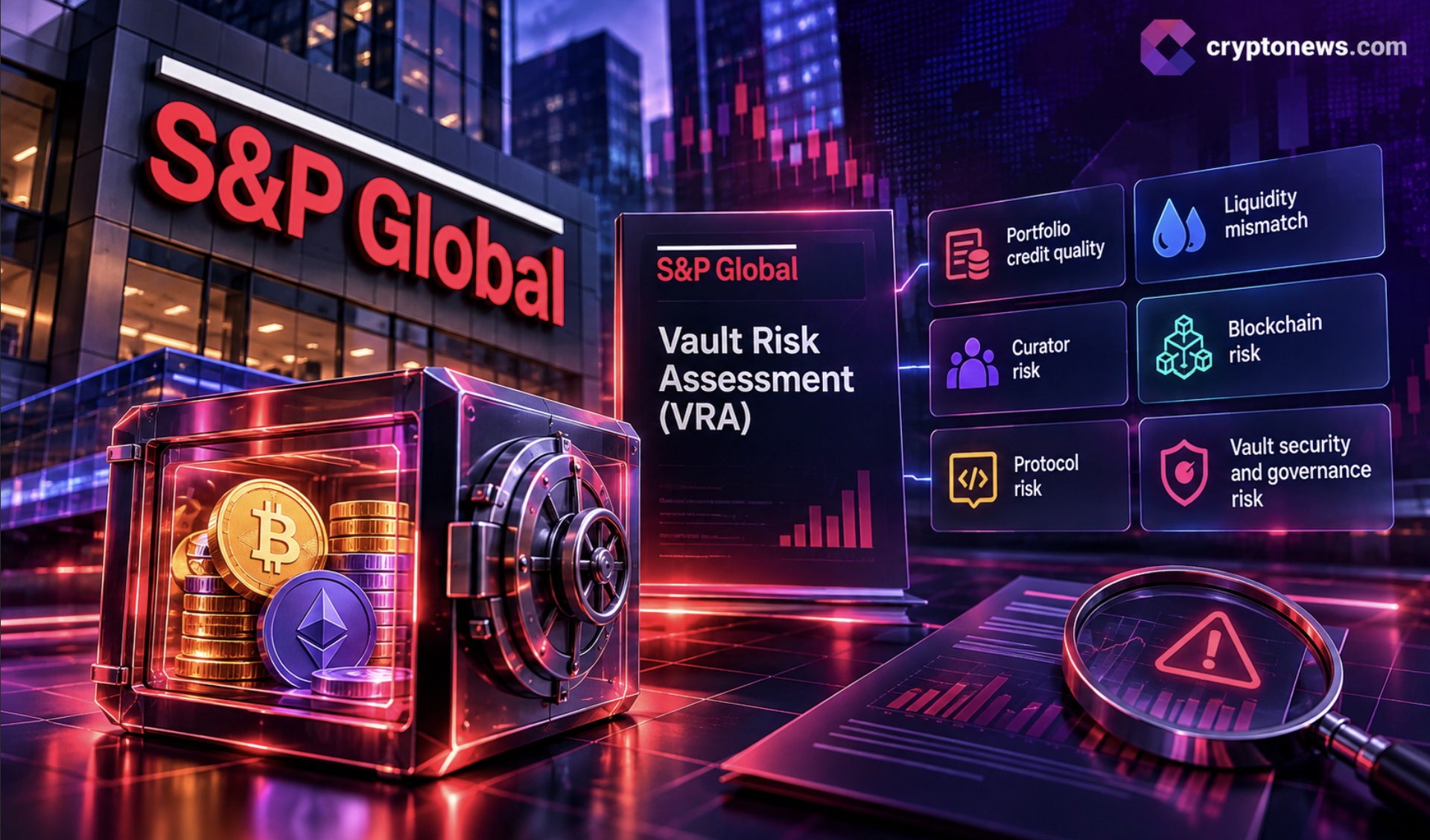
S&P Global Ratings released its Vault Risk Assessment (VRA), providing a forward-looking assessment of 6-risks that would impair investors’ positions in blockchain-based lending vaults. The move comes as deposits in the market attained about $10 billion in September 2026, up from $1.5 billion 2-years earlier.
The framework brings a recognized form of institutional risk analysis into a DeFi lending segment that has scaled rapidly. Its scope is precise: it assesses relative impairment risk, not the attractiveness of a vault’s yield or the creditworthiness of an issuer in the conventional ratings sense.
Digital asset vaults pool investor deposits and deploy them on a blockchain as per to defined strategies. S&P Global explains them as working just like managed fixed income funds, with techniques that may be automated by smart contracts, directed by human managers, or run through a integrated of both.
The 2-figures in the declaration imply growth of about 6.7 times among September 2024 and September 2026, a calculation based on the reported $1.5 billion and $10 billion deposit totals. That expansion increases the amount of capital exposed to vault-specific decisions about eligible assets, liquidity, and management.
How S&P Global Vault Risk Assessment Works?
The VRA is a forward-looking opinion on the overall relative risk of impairment to an investor’s position in a lending vault. Its six factors are portfolio credit quality, liquidity mismatch, curator risk, blockchain risk, protocol risk, and vault security and governance risk.
This matters because vault overall performance relies upon on more than the assets held at a specific moment. The framework considers the credit quality of the portfolio alongside liquidity conditions and risks related with the people or entities curating the strategy, the underlying blockchain and protocol, and the vault’s security and governance.
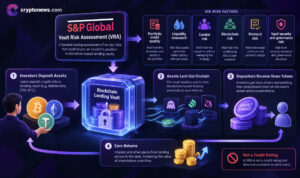
Depositors gets share tokens representing their proportional claims on the vault’s assets and accrued returns. The structure can package lending exposure into an onchain investment vehicle, however tokenized ownership does not make the vault’s risk profile self-explanatory; the method and the conditions below which it works stay materials to an investor’s position.
S&P’s stated boundary is explicit: a VRA isn’t a credit rating and does not comment on yield levels.
Risk Transparency Vs. Performance
The firm mention that the assessment moves beyond transaction transparency towards risk transparency, with the goal of supporting institutions reinforce investment governance and vault selection.
S&P Global Ratings President Yann Le Pallec mention that the company sees demand for impartial risk assessments that connect traditional finance with decentralized markets as digital assets institutionalize. This positioning makes the VRA relevant to institutional crypto investors assessing onchain lending exposure.
The distinction is vital for market participants comparing vaults with related fund structures. A risk label can provide a standardized lens throughout numerous factors; it does not turn the underlying exposure into a conventional fixed income product or make yield and risk interchangeable measures.
S&P stated it’ll publish initial Vault Risk Assessments in future declarations. Its Oct. 4 launch offered no publication date, list of vaults to be assessed, or eligibility schedule, so the launch establishes the analytical framework.