On this page
Facebook AI’s COVID-19 models use self-supervised learning on chest X-rays to predict whether a patient’s condition will worsen within 96 hours, helping hospitals decide how to allocate scarce resources. The work was done with NYU Langone Health and relies on pretraining that needs far less labeled data than conventional approaches.
The pandemic placed a heavy burden on healthcare systems worldwide, especially in developing countries. With no specific cure when the work was reported in early 2021, tools that help clinicians prioritize patients became valuable.
Key takeaways
- Facebook AI released pretrained models that predict deterioration of COVID-19 patients from X-ray radiographs, up to 96 hours ahead.
- The research is part of a collaboration with NYU Langone Health’s Predictive Analytics Unit and Department of Radiology.
- Self-supervised pretraining with momentum contrast reduces the need for large labeled datasets.
- The pretrained models are being open-sourced so other researchers and providers can tune them on their own X-ray data.
Why did healthcare need machine learning for COVID-19?
Clinicians faced an unpredictable disease course and limited hospital resources. Neither a proven antiviral treatment nor an authorized vaccine was available when the original article was written, so reducing the load on healthcare systems was a priority.
Non-clinical methods such as machine learning, data mining and deep learning were seen as promising aids for diagnosis and prognosis of patients. As of mid-2020, at least 651,247 people worldwide had died after contracting the disease, according to the original article.

What did Facebook AI build?
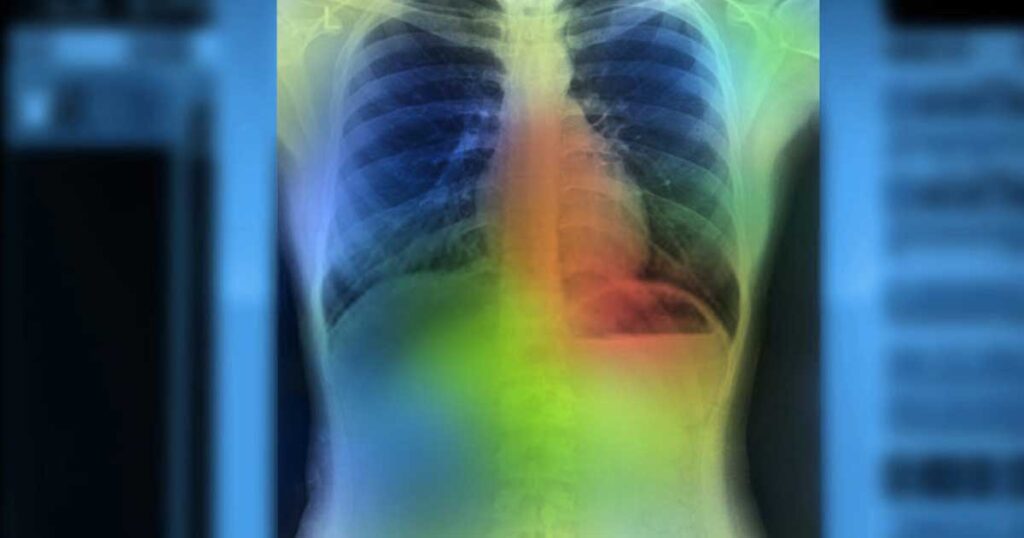
Facebook AI introduced pretrained machine learning models that help doctors forecast how COVID-19 patients will progress, so they can make sound clinical decisions and plan resources. The models predict patient deterioration from X-ray radiographs.
In the research paper, the team showed that self-supervised models based on the momentum contrast technique can learn general image representations that transfer to downstream tasks. The models predicted deterioration up to 96 hours ahead with strong accuracy. The researchers believe this kind of forecast can help providers anticipate the resources needed to treat high-risk patients.
How was the model trained?
The team used the NYU COVID-19 dataset, with more than 26,000 X-ray radiographs from 4,914 patients, to tune the model. The labels indicated whether a patient’s condition worsened within 96 hours of the scan. Self-supervised training achieved better accuracy for predicting an adverse event at all time points, according to the paper.
Why self-supervised learning?
Image-based diagnosis with supervised deep learning is common, but it needs labeled data and costly training. Collecting large datasets from leading clinical centers was difficult during the pandemic. Facebook AI therefore used self-supervised contrastive loss pretraining, then open-sourced the pretrained models so others can tune them on their own datasets.

What is machine learning?
Machine learning is a branch of artificial intelligence that builds algorithms able to learn from data and adjust themselves by optimizing a cost function or objective. In biomedicine it has been applied to high-dimensional structured and unstructured data, including diagnosis of malaria and typhoid, classification of vascular diseases, diabetes assessment and genomic analysis.
Methods fall into four broad types.
| Type | How it works |
|---|---|
| Supervised learning | Learns from labeled examples to predict outcomes, then corrects itself by comparing predictions with real results. |
| Unsupervised learning | Finds hidden patterns in unlabeled data without being told the right output. |
| Semi-supervised learning | Sits between the two, using a small labeled set with a larger unlabeled set. |
| Reinforcement learning | Learns by interacting with an environment through trial and error and delayed rewards. |
What other predictive models exist for COVID-19?
Related studies built supervised models for COVID-19 infection using decision trees, logistic regression, naive Bayes, support vector machines (SVM) and artificial neural networks (ANN). One such study used an epidemiology dataset of positive and negative COVID-19 cases in Mexico. Researchers ran a correlation analysis between dependent and independent features before modeling, and used 80% of the data for training and 20% for testing.

Frequently asked questions
What do Facebook AI’s COVID-19 models predict?
They predict whether a COVID-19 patient’s condition will deteriorate within 96 hours, using chest X-ray radiographs.
Who collaborated on the research?
Facebook AI worked with NYU Langone Health’s Predictive Analytics Unit and Department of Radiology.
Are the models available to others?
Facebook AI said it would open-source the pretrained models so researchers and healthcare organizations can tune them on their own X-ray datasets.
Why does self-supervised learning matter here?
It learns useful image features without requiring every image to be labeled, which eases the shortage of labeled clinical data.
Conclusion
Machine learning gave healthcare providers a way to forecast patient deterioration and plan resources during a crisis with limited treatment options. Facebook AI’s self-supervised approach, built with NYU Langone Health, shows how pretrained models can work with less labeled data and be shared for wider use.