
Free Quiz
Write for Us
Learn Artificial Intelligence and Machine Learning
  • Artificial Intelligence
  • Data Science
    • Language R
    • Deep Learning
    • Tableau
  • Machine Learning
  • Python
  • Blockchain
  • Crypto
  • Big Data
  • NFT
  • Technology
  • Interview Questions
  • Others
    • News
    • Startups
    • Books
  • Artificial Intelligence
  • Data Science
    • Language R
    • Deep Learning
    • Tableau
  • Machine Learning
  • Python
  • Blockchain
  • Crypto
  • Big Data
  • NFT
  • Technology
  • Interview Questions
  • Others
    • News
    • Startups
    • Books
Learn Artificial Intelligence and Machine Learning
No Result
View All Result

Home » Researchers broaden ‘SyMerge’ technology maximizing AI model synergy

Researchers broaden ‘SyMerge’ technology maximizing AI model synergy

Tarun Khanna by Tarun Khanna
July 17, 2026
in Artificial Intelligence, Machine Learning
Reading Time: 2 mins read
0
Researchers broaden ‘SyMerge’ technology maximizing AI model synergy

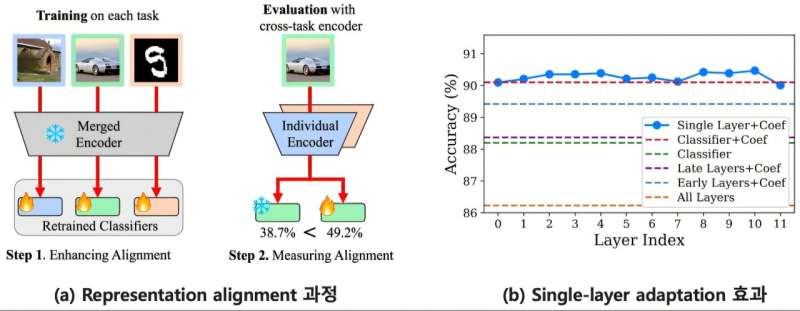
Principles and effects of the AI model merging technology (SyMerge) developed by Professor Sung-Eun Hong's research team at Sungkyunkwan University. (Left) Process of AI knowledge merging and compatibility measurement, (Right) Performance effect achieved by adapting just a single core layer. Image Credit: https://techxplore.com/

Share on FacebookShare on TwitterShare on LinkedInShare on WhatsApp

Sungkyunkwan University (SKKU) declared that an artificial intelligence research team from the College of Computing and Informatics, along with Professor Sung-Eun Hong and researchers Ae-cheon Jeong and Seung-hwan Lee, developed “SyMerge” by a joint study with NAVER AI Lab (Dr. Dong-yoon Han). The framework permit independently trained AI models to trade capabilities and increase overall performance while integrated into a single system.

The research findings were accepted and introduced at the 43rd International Conference on Machine Learning (ICML 2026).

Existing model-integrating strategies confronted technical bottlenecks in constructing multitasking AI. Merging models with different expertise often caused their knowledge to collide, outcomes in “task interference”—a phenomenon in which performance drops considerably compared with the original models. Until now, academia has centered closely on minimizing or preventing such conflict.

Also Read:

Google opens up latest AI models to 200 European researchers

AI agents develop their very own ‘artificial natural language’ to communicate about complex data

TikTok CEO Predicts Major AI Scientific Breakthroughs Within 3-Years

Microsoft Introduces Maia 300 AI Chip to Decrease Nvidia Dependence

Shifting the paradigm, the research team targeted on creating synergy in which models actively supplement each other instead of simply avoid interference. The team identified that coordinating and optimizing the integrating ratio of one specific layer—the task-particular layer—among several internal layers can maximize compatibility among different models.

In specific, the newly evolved “SyMerge” technology announces an “Expert-Guided Self-Labeling” method. When encountering new, unlabeled data, the system trains itself by referencing the prediction capabilities of current models, which feature as experts. This permits the AI to navigate corrupted or altered data and maintain overall performance even under adverse conditions.

Furthermore, whilst conventional integrating strategies were limited to AI models derived from identical pretrained models, “SyMerge” successfully incorporates architectures with absolutely different pretrained origins—a feat previously deemed impossible.

Experimental results show that “SyMerge” obtains state-of-the-art (SOTA) performance throughout three core pillars of AI: image classification, computer vision-based prediction and natural language processing (NLP), showing its versatility and performance.

“This study represents a major milestone that shifts the paradigm of AI model integrating from ‘interference prevention’ to ‘mutual synergy creation,'” Hong stated. “By significantly decreasing the huge computing costs related with retraining AI, this technology will greatly make contribute to building lightweight yet highly versatile multitasking AI efficiently in the future.”

ShareTweetShareSend
Previous Post

AI-powered election forecasts reveal hidden preferences inside language models

Next Post

Musk’s Memphis AI Data Centers Fuel a National Backlash

Tarun Khanna

Tarun Khanna

Founder DeepTech Bytes - Data Scientist | Author | IT Consultant
Tarun Khanna is a versatile and accomplished Data Scientist, with expertise in IT Consultancy as well as Specialization in Software Development and Digital Marketing Solutions.

Related Posts

Inside Mark Zuckerberg’s decision to pull the trigger on Meta’s AI agent
Artificial Intelligence

Inside Mark Zuckerberg’s decision to pull the trigger on Meta’s AI agent

October 12, 2026
OpenAI Denies Firing Researchers Over AI Safety Warnings
Artificial Intelligence

OpenAI Denies Firing Researchers Over AI Safety Warnings

October 12, 2026
France’s Mistral introduces latest model in sovereign AI push
Artificial Intelligence

France’s Mistral introduces latest model in sovereign AI push

October 8, 2026
AI behaves more like a brain than a database—cognitive science’s role in its origin story supports explain why
Artificial Intelligence

AI behaves more like a brain than a database—cognitive science’s role in its origin story supports explain why

October 8, 2026
Next Post
Musk’s Memphis AI Data Centers Fuel a National Backlash

Musk’s Memphis AI Data Centers Fuel a National Backlash

Leave a Reply Cancel reply

Your email address will not be published. Required fields are marked *

9 + 1 =

TRENDING

Trump stated that the United States will Control Hormuz, Crypto at His Mercy

Trump stated that the United States will Control Hormuz, Crypto at His Mercy

Image Credit: https://cryptonews.com/

by Tarun Khanna
July 14, 2026
0
ShareTweetShareSend

ChatGPT search is developing quickly in Europe, OpenAI data suggests

ChatGPT search is developing quickly in Europe, OpenAI data suggests

Photo Credit: https://techcrunch.com/

by Tarun Khanna
April 22, 2025
0
ShareTweetShareSend

AI doesn’t create bias, it inherits it. How do we ensure equity when it comes to automated decisions?

AI doesn’t create bias, it inherits it. How do we ensure equity when it comes to automated decisions?

Image Credit: https://techxplore.com/

by Tarun Khanna
May 13, 2026
0
ShareTweetShareSend

What is Codex, OpenAI’s latest AI coding agent capable of multitasking?

What is Codex, OpenAI’s latest AI coding agent capable of multitasking?

Photo Credit: https://indianexpress.com/ In April this year, OpenAI launched another AI coding agent tool called Codex CLI.

by Tarun Khanna
May 19, 2025
0
ShareTweetShareSend

Navigating the Impact of Artificial Intelligence on Job Markets

Navigating the Impact of Artificial Intelligence on Job Markets
by Tarun Khanna
April 19, 2024
0
ShareTweetShareSend

International RegLab Examines AI in Nuclear Power Plant Operations

International RegLab Examines AI in Nuclear Power Plant Operations

Photo Credit: https://opendatascience.com/

by Tarun Khanna
April 6, 2026
0
ShareTweetShareSend

DeepTech Bytes

Deep Tech Bytes is a global standard digital zine that brings multiple facets of deep technology including Artificial Intelligence (AI), Machine Learning (ML), Data Science, Blockchain, Robotics,Python, Big Data, Deep Learning and more.
Deep Tech Bytes on Google News

Quick Links

  • Home
  • Affiliate Programs
  • About Us
  • Write For Us
  • Submit Startup Story
  • Advertise With Us
  • Terms of Service
  • Disclaimer
  • Cookies Policy
  • Privacy Policy
  • DMCA
  • Contact Us

Topics

  • Artificial Intelligence
  • Data Science
  • Python
  • Machine Learning
  • Deep Learning
  • Big Data
  • Blockchain
  • Tableau
  • Cryptocurrency
  • NFT
  • Technology
  • News
  • Startups
  • Books
  • Interview Questions

Connect

For PR Agencies & Content Writers:

connect@deeptechbytes.com

Facebook Twitter Linkedin Instagram
Listen on Apple Podcasts
Listen on Google Podcasts
DMCA.com Protection Status

© 2024 Designed by AK Network Solutions

Welcome Back!

Login to your account below

Forgotten Password?

Retrieve your password

Please enter your username or email address to reset your password.

Log In
No Result
View All Result
  • Artificial Intelligence
  • Data Science
    • Language R
    • Deep Learning
    • Tableau
  • Machine Learning
  • Python
  • Blockchain
  • Crypto
  • Big Data
  • NFT
  • Technology
  • Interview Questions
  • Others
    • News
    • Startups
    • Books

© 2023. Designed by AK Network Solutions