Nvidia’s (NVDA.O), $500 billion AI financing platform is not unlikely to disappear with co-founder Jensen Huang’s departure, however losing its chief dealmaker could make it harder to bankroll some of the riskier infrastructure bets driving the AI boom.
Analysts are increasingly worried about a possible pullback in AI financing, particularly in a some of Nvidia’s investments in AI startups and neoclouds — specialized cloud providers that rent out AI computing capacity — which the chip company has preferred.
And while the financing platform for AI infrastructure is anticipated to persist under interim CEO Colette Kress, they say there can be an initial pause as the company and financiers assess this program’s future direction.
“Nvidia’s CEO transition adds additional uncertainty,” mention Morningstar analyst Brian Colello.
Nvidia’s financial partners, which includes Apollo (APO.N), BlackRock (BLK.N), Blackstone (BX.N), Brookfield Asset Management (BAM.N), Goldman Sachs (GS.N), and KKR (KKR.N), are still discussing deals to finance AI companies, as per two people acquainted with the matter. One of the people added that there has been no indication from Nvidia of a pause.
Nvidia did now not respond to a request for comment.
Nvidia’s partners highlighted their aim to persist working with the platform. “We significantly value the relationship among our teams and look forward to persist with our work together,” Sikander Rashid, worldwide head of AI infrastructure of Brookfield Asset Management, mention in an e mail.
CEO Huang’s Departure Creates Uncertainty
But analysts said it may not be business as usual for the platform when it comes to future deals.
“We do not anticipate presents commitments change, but new deals could take longer or need more compensation as investors look for reassurance about Nvidia’s role,” JPMorgan credit analyst Erica Spear stated in a note.
Nvidia and its partners may also run up against a loss of appetite from investors for latest deals, as interest rates rise and the next US Congress considers pushing back against data-center buildouts, she stated.
Data-center opponents were among the biggest winners in this month’s US midterm elections, which surpassed control of Congress to Democrats in component due to a shift in the public mood on AI.
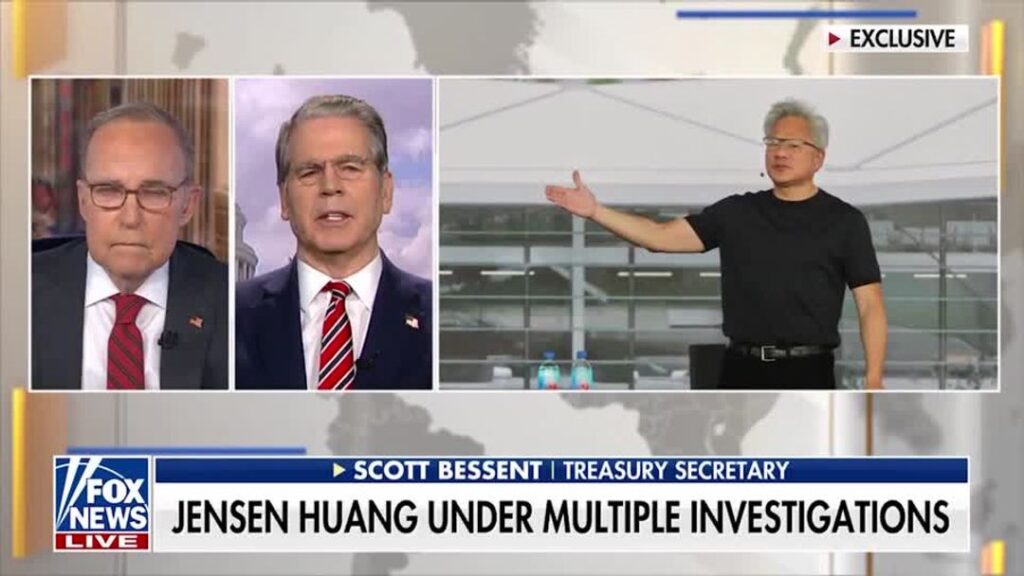
Huang stepped down as Nvidia’s CEO on Thursday after reports of extramarital affairs, which include one related to a suspected Chinese spy that raised questions over exports of the company’s advanced AI chips to China.
Huang had introduced the AI financing platform in August.
At that time, he said it was designed to deal with issues about circular financing, wherein a company supports to finance purchases of its own products — and in so doing compounds its exposure to any potential downturn.
He promised that the partnership, which has yet to declare a deal, could bring independent institutional capital into the AI infrastructure market, while Nvidia would restriction its guarantees to a maximum of 25%.
Outside of the $500 billion platform, Bank of America analysts evaluate Nvidia as of August had made $70 billion of equity investments in AI-sector companies, together with stakes in neocloud groups such CoreWeave (CRWV.O), and in technology startups.
Nvidia also offered $230 billion in financial guarantees, they stated, the maximum current in August when it agreed to guarantee up to $105 billion in financing to support OpenAI lease a sprawling data center in Ohio under development by SB Energy (SBE.O), owned by Japan’s SoftBank (9984.T), It is one of the chipmaker’s largest infrastructure financing commitments.
Investors Focus On Contracts Or Guarantees
In Nvidia’s uncertain post-Huang future, analysts stated, the new financing platform may shift its target to more established hyperscalers as lenders and credit investors — who gives funds to Nvidia’s partners— worry about risk.
Huang were one of the visionary voices driving a lot of the AI boom, supporting to convince companies, governments and investors to commit awesome amount of capital to AI infrastructure, JPMorgan’s Spear said.
He had envisioned Nvidia’s platform using the company’s very own chips as collateral with limited guarantees, to present AI developers developers access to Nvidia’s computing power. But lenders and credit investors are calling for future financing to be sponsored by the recipients’ customer contracts or financial guarantees.
“The beauty of securitized products, and of ABF (asset- backed finance) mainly, is that our repayment relies upon completely on assets and contracts,” mention Edwin Wilches, co-head of PGIM Credit’s Securitized Products team.
“As long as they keep producing compute, we get repaid by the parties leasing that capacity.”
The platform’s declared had coincided with Nvidia’s new neocloud structure, beneath which it gives financial guarantees for initial investment in neocloud specialists in exchange for shared revenue.
The plan, analysts stated, might also now pivot closer to bigger, global players that carry much less financial risk.
“We would anticipate the $500 billion pool of third-party capital that NVIDIA had raised is more likely to go to more established players — larger hyper-scalers, primarily,” Joseph Moore, analyst at Morgan Stanley, stated in a note.
“To be clear, we would still anticipate close to 25% of revenues to be neoclouds, however with more coming from established players.”