On this page
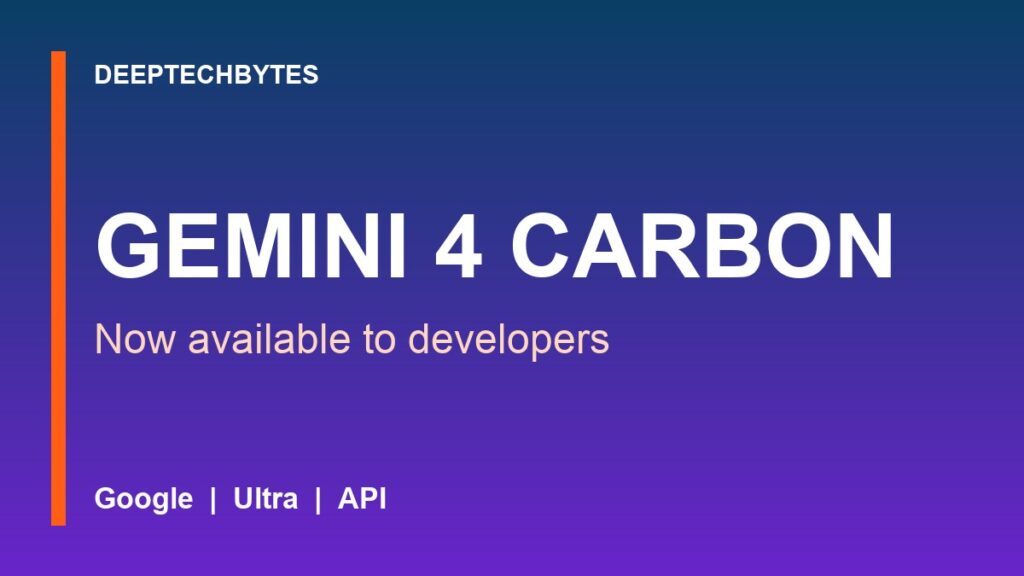
Google announced Gemini 4 Carbon on October 28 and widened access on November 10. It is now available to paying developers, and AI Ultra subscribers can use it in the Gemini app, AI Mode and the Antigravity coding tool, according to 9to5Google and Digital Trends. Google positions it as the model for the hardest tasks.
Key takeaways
- Announced October 28, 2026; broader availability from November 10.
- Sits above Gemini 4 Argon, which stays available and remains the default choice for most software and knowledge work, per Google.
- Reported to cost the same as Argon.
- One unified context limit of 1,048,576 tokens covering input and output together.
What is new
Google highlights “significant gains” in coding, agentic tasks and cyber defence. The developer docs describe three thinking levels (low, medium and high, with medium as the default for this model), letting teams trade speed and cost against depth of reasoning. In the Gemini app the model is labelled for the “most complex work”.
Agents and security claims
Antigravity is previewing a /swarm command that turns a single prompt into a coordinated team of agents you can follow in real time. On security, Google says the security firm Wiz used Carbon to scan two major SaaS providers and found zero-day vulnerabilities in under two hours. That is a vendor-reported result; no independent reproduction has been published yet.
Benchmarks: read with care
Coverage reports that Carbon ranks first on version 5.0 of the Artificial Analysis Intelligence Index with a score of 59. Index rankings move quickly as rivals release models, and benchmark results do not always predict how a model behaves on your own workload.
Who should try it
- Developers building multi-step agents or working across large codebases, where the large context window helps.
- Security teams evaluating AI-assisted vulnerability discovery, ideally with their own test targets.
- Everyone else may find Argon sufficient and cheaper to run at scale.
The practical advice is to test Carbon on a handful of your real tasks, compare quality and latency against Argon, and only then decide where the extra capability is worth routing to.